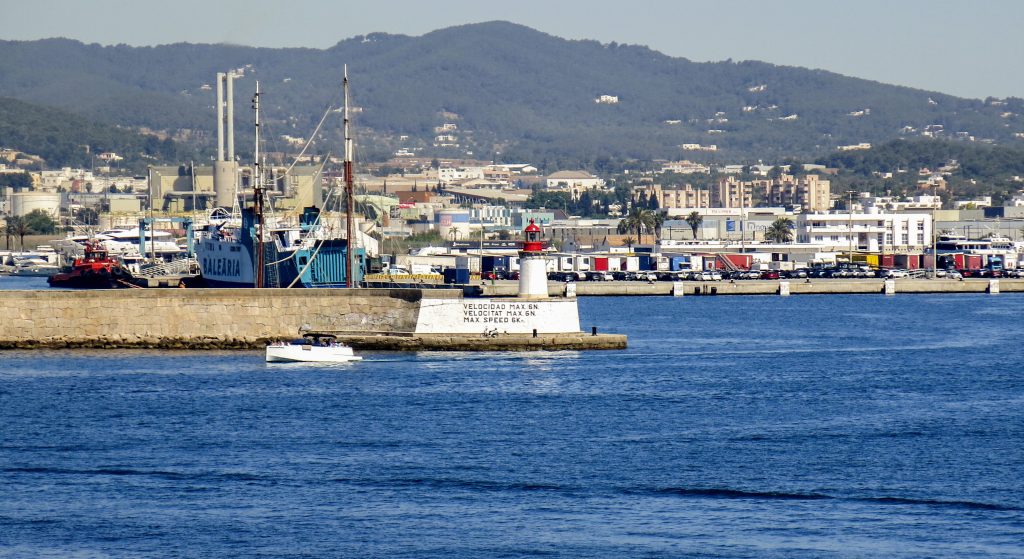
I always spot Dalt Vila first when taking the slow ferry over from the mainland. The old town sits on a hill. Massive 16th-century walls face the water. Locals call the city Eivissa. It is the administrative centre of the island and the absolute best place to base yourself if you actually want to walk to dinner instead of fighting for a taxi every night.
Dalt Vila and the Walk to the Top
Walk up the steep ramp to the Portal de ses Taules. This main entrance has a wooden drawbridge and a couple of headless Roman statues by the gate. The cobblestones get dangerously slick in July if you wear flat leather sandals. People end up resting on the stone steps halfway up just to catch their breath. Inside the walls the streets wind upward past residential courtyards and small galleries selling overpriced white ceramics.
And eventually you reach the top. The Cathedral of Our Lady of the Snows sits right at the summit. It is an odd mix of Gothic and Baroque architecture built directly over a Roman temple. You get a clear view of Formentera from the square out front. The Archaeological Museum is next door in the old university building. It holds Phoenician artifacts dug up around the island over the last hundred years.
Sa Penya
Sa Penya clings to the slope below the fortress. It used to be a fishermen’s quarter. Now it’s a tight grid of alleys packed with boutiques selling 300-euro linen shirts. Walk down Carrer de la Mare de Déu around 8 PM on a Thursday when the bars start opening their doors and pulling tiny tables out into the street while promoters try to hand you flyers for whatever club night is happening. You smell patchouli and hear deep house music echoing off the stone. It gets loud fast.
The Harbour and Marina Botafoch
The main harbour occupies the flat land at the bottom. Buy tickets for the Formentera ferry from the little kiosks along the waterfront. A same-day return runs exactly 29.50 euros on the Trasmapi fast boat. But the port area itself has plenty going on. Walk the Paseo Marítimo to find dozens of seafood places displaying their daily catch on ice.
Further along you hit Marina Botafoch. This is where the massive private yachts dock for the summer. The restaurants here match the boats. Places like Cipriani charge premium prices for a plate of pasta. A completely different crowd from the people drinking two-euro beers up in the old town.
Puig des Molins
Most visitors ignore the western side of the city. But just outside the old town walls is the Puig des Molins. Underneath the ground here is an enormous Carthaginian necropolis. Thousands of ancient tombs are cut directly into the rock. You can actually climb down into a few of the open burial chambers. The Monographic Museum (Museu Monogràfic des Puig des Molins) next door holds the terracotta figures pulled out of the dirt during the 1920s excavations.
Walking the Town
You really need to walk. Parking near the centre is a nightmare. The blue-zone metered spots are almost always full by 9 AM anyway. Go into Dalt Vila around sunset. The stone walls turn a deep orange colour before the floodlights kick on for the night. If you come in late May the weather is cool enough to actually enjoy the steep climb up the fortress without sweating through your shirt before you even reach the first lookout point. Summer afternoons are brutal. Find a spot in one of the squares and order a cold Estrella. Watch the crowds filter through the old gates.
Photo: Vicenç Salvador Torres Guerola, via Wikimedia Commons