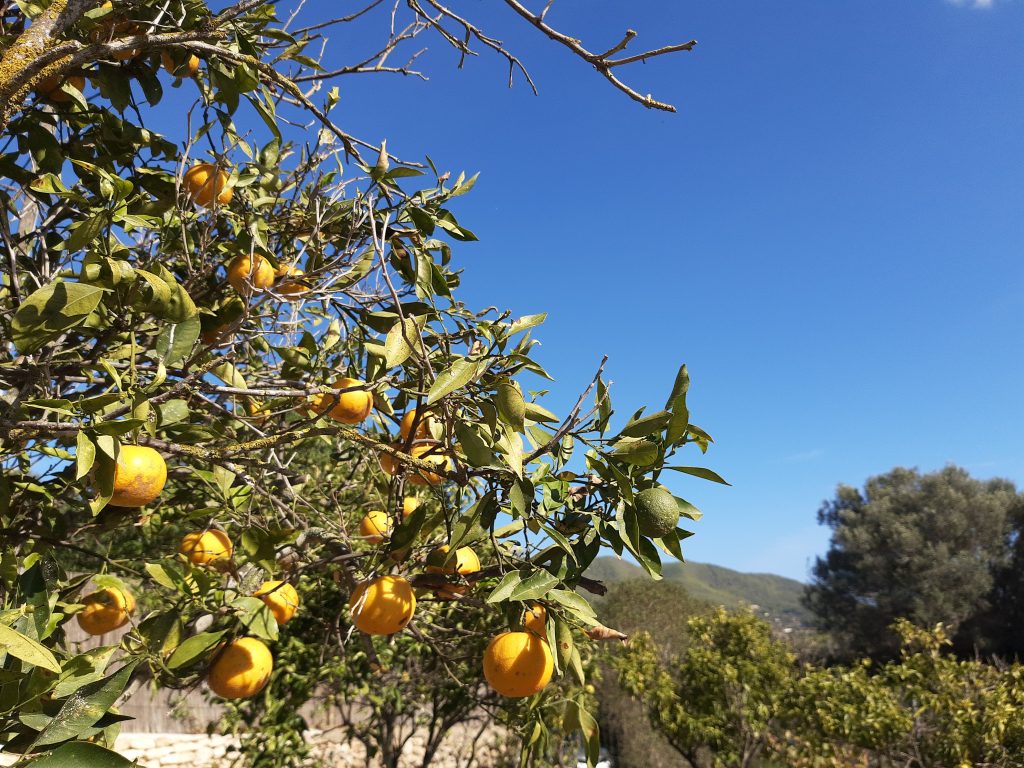
Most people land at the airport and immediately funnel south toward the massive clubs around Playa d’en Bossa. Go north instead. Up in the municipality of Sant Joan de Labritja things slow way down. The landscape shifts into thick pine forests and isolated whitewashed farmhouses. I usually rent a battered little Fiat Panda for the week just to handle the narrow dirt tracks up here. Anything wider is going to lose a side mirror on a dry stone wall when a tractor forces you to reverse blindly around a corner.
The Heart of the Countryside: Sant Joan Village
The village of Sant Joan sits right in the middle of this region. You will find an 18th-century church next to a tiny square where older men drink cortados all morning. Don’t let that sleepy atmosphere fool you. Some of the best local food on the island hides on these backstreets. A plate of tomatoes and olive oil runs about 14 euros at Giri Cafe. It is expensive for what it is. But you’ll pay it gladly once you taste it. Then on June 24th the entire village wakes up for the Festa de Sant Joan. Locals light massive bonfires directly on the pavement and people jump over the flames to burn away bad luck while fireworks pop continuously overhead through a thick haze of smoke.
Coastal Charms: From Family Resorts to Secluded Coves
Drive to the top edge of the map to hit the coastline. The beaches up here look completely different from the packed southern shores.
Portinatx: The Northern Resort
This is the largest resort area in the north. It centers around a few different sandy bays. S’Arenal Gros and S’Arenal Petit are the main ones. You can walk over to Playa Es Port if the first two are full. The water stays shallow for a surprisingly long distance out. Families flock here because the swimming is easy and you can usually find parking if you arrive before 10 AM. There are plenty of apartments and decent restaurants around the bay. You get the convenience of a holiday town without the crushing density of San Antonio.
Port de Sant Miquel and Benirràs
Port de Sant Miquel is a deep horseshoe-shaped cove on the northwest edge. The sand has a coarser texture that sticks to wet towels. Just up the steep access road sits the actual village of Sant Miquel de Balansat. They built it far inland centuries ago because pirate raids kept wiping out coastal settlements. That history explains why the local church looks exactly like a military fortress.
And then there is Benirràs. The beach gets busy enough during a regular Tuesday. Sundays are another story entirely. Right around sunset dozens of locals drag bongo drums down to the sand and start playing out of nowhere. The drumming gets louder as the sky gets darker. You absolutely must arrive by 3 PM. If you show up later you will end up parking a mile away and walking down the dusty access road in the brutal afternoon heat while scooters fly past your elbows.
Inland Exploration: Scooter Routes and the Hippy Market
Renting a 125cc scooter is the most practical way to see the interior roads. You pass endless rows of almond trees. Las Dalias Hippy Market sits right on the main road connecting Sant Carles and Sant Joan. It operates every Saturday all year round. In the summer they add a Monday night market. I always recommend the Monday option because it is infinitely easier to walk through when the midday heat finally breaks and the crowds thin out. You can buy handmade leather bags. Or dig through racks of vintage clothes.
Eventually you should head toward the village of Sant Vicent and pull over at the mirador. You look straight down raw cliffs into the water. It is a massive drop. There is no fence and the wind whips hard off the sea. So keep a tight grip on your phone. Take in the absolute silence for a minute before turning the key in the ignition and heading back down the mountain.
Recommended experiences
A few bookable experiences related to this topic:
Fotografie: Gerda Arendt, via Wikimedia Commons